


The reggae that had been bumping softly throughout the gym for nearly an hour suddenly stopped, and about a dozen barefoot children stood and lined up along the edge of a bright yellow mat. Each dressed in a different colored gi, the traditional uniform worn by Brazilian jiu-jitsu competitors, the students waited to be handpicked for a one-on-one fight.
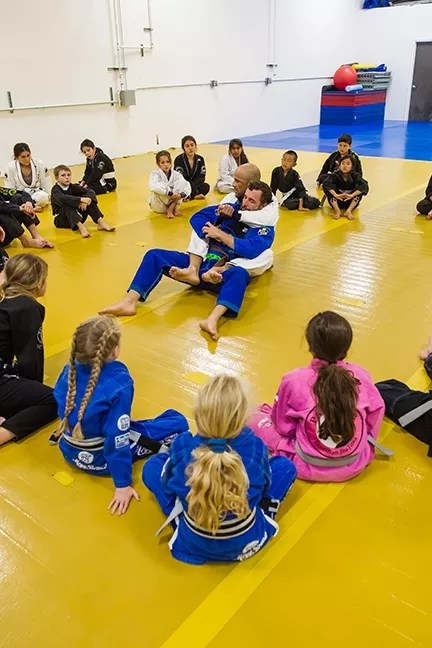
An instructor pointed out two smaller students, Payton and Jada Giddings, and the 10-year-old twins bolted out of line to the center of the mat, clearly ready to try out their still developing technique. The girls–almost identical in physicality, clothing, and even belt rankings–faced each other and bowed.
The “ding, ding, ding” of a boxing bell sounded, and Payton instantly lunged at Jada’s legs, bringing her sister down with a single swift motion.
“Don’t stay there, Jada!” one instructor shouted as he slowly circled the girls, watching closely for less than perfect form in need of tweaking.
Jada, who looked irreversibly stuck, somehow maneuvered her way out of Payton’s grasp and rolled onto her side. She seemed to be making a comeback until Payton swung her legs across Jada’s chest and unleashed the armbar, one of Payton’s favorite and most frequently used moves, which earned her the straightforward nickname, “Armbar Payton,” in class.
Payton won the match before the next bell sounded, but there were no hard feelings, and the girls bumped fists as they returned to line, where bystanders waited with congratulatory high-fives and pats on the back for both.
Since Payton and Jada started training at Paragon of Santa Maria three years ago, they’ve developed a close-knit group of friends, learned endless self-defense techniques, and competed in a few jiu-jitsu tournaments, according to their mom, Christina Giddings.
It’s made the girls more confident, Christina said, a task that would have seemed nearly impossible a few years ago, when the twins started first grade at Joe Nightingale Elementary School and caught a glimpse of the bullying that would become a constant battle for the next few years of their lives.
It can be difficult to quantify bullying–the aggressive, intentional, and unwanted attention that many children are faced with in and outside the classroom–but research collected by the U.S. Department of Health and Human Services estimates that 1 in 5 children are bullied at some point during their schooling in the U.S. It’s an age-old issue that can greatly impact everyone involved, and researchers are still working to find real solutions.
But for many kids–children who are bullied, those who bully, and bystanders alike–simply finding a special activity or hobby to get active in and a community to be apart of can be the best deterrent of bullying behavior.
Payton and Jada found that in jiu-jitsu, Christina said, and what started as her last-ditch effort to help her kids defend themselves, slowly blossomed into the twins’ favorite thing to do and the hour they look forward to every day.
“It’s not like they just come here and learn stuff,” Christina told the Sun. “It’s like a whole family. You’ve got everybody backing you up.”
The ABCs of bullying
The way people think about bullying is changing, according to Margie Hunt, a licensed marriage and family therapist and regional manager at Santa Maria’s Child Abuse Listening Mediation (CALM) office.

Behavior that was once considered a “rite of passage” for children is now being addressed as a serious problem, Hunt said.
“Bullying is not unlike any other type of abuse or trauma,” Hunt told the Sun. “It’s a traumatic childhood experience, and the effects are just like any other abuse or trauma.”
In the Santa Maria area, Hunt said indigenous and newly immigrated students of all ages are often ridiculed over language barriers and cultural differences. Students of low-income families, many of whom she said have experienced homelessness or are living in poverty, are also commonly bullied because of their economic statuses.
And although anyone can be targeted, Hunt said some students, typically those who are perceived as being different from their peers in one way or another, are at a heightened risk. Anything from being under or overweight, wearing glasses, or identifying as LGBTQ, to being new at school or having a mental health issue, could increase a child’s risk of being bullied.
For Payton and Jada, it seemed to be their small frames that made them stand out as easy targets among their larger peers, Christina said. And although both girls are essentially the same size, Payton got the worst of it. Maybe, Christina said, because Payton’s the more outgoing of the two.
First it was one boy, who Payton said she had seen hitting another girl at the beginning of first grade. Soon he was calling Payton names, pulling her hair, chasing her, and eventually, Christina said other students joined in. They pushed her off playground equipment, hit her with lunch boxes, and dragged her across pavement outside the school.
The harassment had an impact. Although Payton’s tormentors mostly let Jada be, Christina said she watched as both her girls became increasingly anxious and self-conscious. They genuinely feared going to school every day, she said, and constantly faked stomach aches to get out of going.
Those reactions are common among children who have been bullied, according to Hunt, who said bullying can cause long-term chemical and structural damage to the brain. It’s traumatic, she said, for everyone involved.
Researchers have found that kids who are bullied, kids who bully, and bystanders are all similarly impacted by the behavior, Hunt said.
Kids who are bullied are more likely to experience depression and anxiety, physical health issues, and lowered academic achievement, according to the U.S. Department of Health and Human Services, all behaviors that could last into adulthood. Children who bully, whom Hunt said often come from violent or traumatic homes, are more likely to abuse alcohol or drugs, drop out of school, and abuse their partners as adults. Even bystanders are impacted and are more likely to miss school and develop mental health issues.
“There are so many effects,” Hunt said. “It’s just really a chronic health condition.”
But Hunt said the damage can be reversed and, better yet, prevented.
CALM, which provides evidence-based treatment to traumatized children on the Central Coast, offers trauma-focused cognitive behavioral therapy to kids under 18 who are refered by teachers, law enforcement officials, school counselors, or pediatricians. The program helps kids and their parents bond, Hunt said, because children with strong attachments to caregivers are less likely to bully.
CALM staffers also teach various coping and social skills, offer positive means of communication, and help children learn to identify and handle their emotions appropriately. Those skills are useful for anyone affected by bullying behavior, Hunt said.
She also has tips for parents struggling to help their children with bullying at school. Parents, she said, should always take bullying seriously and report any of their children’s claims to administrators. They can also teach kids to assertively address bullying socially and physically, which Hunt said often discourages the behavior.
Modeling appropriate social behavior is also huge, Hunt said, as is simply encouraging children to participate in activities and hobbies they love.
“I think part of it is children who feel connected to some type of activity are less likely to feel isolated or helpless,” Hunt said. “If they’re involved in something that they’re successful at, it really helps their self-esteem.”
Jiu-jitsu as a deterrent
Christina said she tried everything to make the bullying stop–she called teachers and administrators, wrote letters, and eventually confronted other parents. Students were talked to and reprimanded, but it didn’t seem to work. A year passed, the girls entered second grade, and nothing changed.

Then her brother mentioned Paragon of Santa Maria. He said he knew some of the instructors, and thought maybe the girls would feel safer at school if they were stronger, if they could fight back.
“And I thought, ‘At this point, what else can I do?'” Christina said. “Even if I homeschool them they’ll still need social stuff. And there’s nothing wrong with learning how to defend yourself.”
The girls were shy on the mat at first, but the instructors were nice and encouraging–so were the other students. Soon the girls had a group of friends at the gym and they were actually getting good at jiu-jitsu, good enough that they wanted to train every weekday. Eventually they started winning matches at local competitions, and now Christina said their rooms are filled with medals.
It’s been a huge confidence booster for the twins, who are now fifth graders at Joe Nightingale Elementary and helpers in the lower level jiu-jitsu classes.
It’s a pattern that Lance Glynn said he’s seen repeated many times throughout his years owning Paragon of Santa Maria.
“I have 135 kids in my program, and I can honestly say probably half those kids have been bullied,” Glynn told the Sun. “That I know of.”
For years local parents like Christina have brought their children to Glynn, desperate to keep their kids safe. When Glynn first opened up shop about 10 years ago, he and his business partner offered a separate anti-bullying program. When they realized how many of their students were being impacted by bullying at school, they incorporated the program into all Paragon classes.
“It’s super sad,” Glynn said. “Parents bring them in here because they have to defend themselves.”
And that’s what Brazilian jiu-jitsu is all about. As a martial art that focuses largely on ground fighting, Glynn said it’s easy for a small fighter to beat a much larger competitor using superior technique alone. In his classes, students of varying sizes and genders pair off for matches every day.
Jiu-jitsu doesn’t involve punching or kicking, which makes it less nerve-racking for students like Payton, who are often hit and kicked by their peers at school. And while Glynn does not condone fighting at school, if one of Glynn’s students did need to use jiu-jitsu, there wouldn’t be hitting involved. A student of Glynn’s, he said, would know how to use a submission hold to stop his or her attacker.
Payton said she’s only had to use jiu-jitsu a few times at school since she started training at Paragon. When she was in third grade, she said a girl pulled her behind a building out of sight during recess and choked her from behind. Because of jiu-jitsu, Payton knew to keep her chin tucked down close to her neck, and she said she held that position until she was saved by the bell–literally.
“If I wouldn’t have tucked my chin, I would have passed out probably,” she told the Sun.
But for the most part, the respect for others and self-control that are also taught in most martial arts classes have helped Payton and Jada walk away from their bullies with their heads held high.
Those same components of jiu-jitsu also help kids who’ve exhibited bullying behavior, Glynn said, and those kids need help, too.
“Different families are dealing with different stuff,” Glynn said. “So if we can do anything to better the kids and how they act, it’s good.”
A community effort
Of course, not every family can afford to put their kids in jiu-jitsu. At Paragon of Santa Maria, classes can cost anywhere from $69 to $129 a month, and most club sports programs in the area cost about the same or more. Therapy and counseling can be even more expensive.
But Brian Zimmermann, director of Pupil Personnel Services with the Santa Maria-Bonita School District, said teachers and administrators provide similar services for their students–free of charge.
Outreach consultants are stationed at each of Santa Maria-Bonita’s 20 schools, and marriage and family therapists are available at the district’s junior high schools. The consultants, who are paid for by the district and provided by Fighting Back: Santa Maria Valley, a nonprofit aimed at decreasing violence within the community, offer free counseling services to all students affected by bullying.
They also teach an anti-bullying curriculum, Second Step, that gives elementary students the social skills needed to make friends.
In the Orcutt Union School District, where Payton and Jada attend school, similar attempts to address bullying have been taking place since before 2016.
When bullying does occur, Zimmerman said it has to be dealt with immediately. The district often contracts with Fighting Back: Santa Maria Valley and the Council on Alcoholism and Drug Abuse, groups that both offer parent and child mitigations and programs to address and treat children who have been bullied, as well as those who display bullying behavior.
“So we have a lot of support in the community,” Zimmerman said.
The district also provides a variety of after-school clubs and sports programs, which Zimmerman said play a huge part in helping students cope with harassment.
When Zimmerman was the principal at Fesler Junior High School, he said he worked to develop clubs that were centered on students’ interests. The robotics club was particularly successful, he said, and it gave participating students a new group of friends and sense of belonging. They even won some local robotics competitions, Zimmerman said.
“That was really big for self-esteem,” he told the Sun, adding that most bullies won’t target confident kids who are constantly surrounded by friends. “You’re not alone.”
Still, Zimmerman said, “everyone deals with students who just wont stop bullying.”
Payton and Jada still face one or two kids like that at school, Christina said. But her girls are less anxious now, and they’ve made friends at Paragon who watch out for them at Joe Nightingale.
It’s not The Karate Kid, and the problem hasn’t completely disappeared, but Christina said jiu-jitsu has helped Payton and Jada stave off some of the bullying that so deeply impacted their first few years of elementary school in Orcutt. The Paragon gym is where the girls can escape from all the stressors of school, where they hang out with friends, and where they help younger students practice.
It’s even where Christina works now. It’s like a second home.
Christina smiled as she watched the twins practice on July 27, laughing with friends as they wrestled on the ground.
“So yeah,” she said, “I think jiu-jitsu has helped them immensely.”
Contact Staff Writer Kasey Bubnash at kbubnash@santamariasun.com.
This article appears in Aug 16-23, 2018.
