


On Dec. 18, 2011, the last convoy of U.S. troops left Iraq, ending a war that spanned almost nine years and two presidencies.
President George W. Bush, with the approval of U.S. Congress, ordered troops to invade Iraq in 2003 to search for weapons of mass destruction and free the Iraq people from the oppressive leadership of dictator Saddam Hussein.

The conflict started with nonstop missile attacks on Baghdad, and later expanded to include ground combat. Approximately 21 days after the initial attack, American military forces—with aid from British, Polish, and Australian forces—succeeded in ousting Hussein, who was later captured, tried for war atrocities, and executed in 2006.
For the next seven-plus years, a coalition of American and other forces worked to expel militant factions, train native forces to defend themselves, and bring aid to the Iraqi people while helping them set up a democratic government.
Whether those forces accomplished their mission is still up for debate, but what is clear is that those efforts came at an extremely high price. It’s estimated that the war effort cost the United States billions of dollars, and almost 4,500 American and tens of thousands of Iraqi lives.
Now the Iraqi government and people, at their own behest, have been left to fend for themselves, and are facing insurgents, sectarian tensions, and the challenge of maintaining a fragile democracy.
On Dec. 14, President Barack Obama addressed troops at Fort Bragg in North Carolina in observance of the war’s end.
“As your commander-in-chief, I can tell you that it will indeed be a part of history,” Obama told the troops, according to a transcript of his speech from The New York Times. “Those last American troops will move south on desert sands, and then they will cross the border out of Iraq with their heads held high. One of the most extraordinary chapters in the history of the American military will come to an end. Iraq’s future will be in the hands of its people. America’s war in Iraq will be over.
“It’s harder to end a war than begin one. Indeed, everything that American troops have done in Iraq—all the fighting and all the dying, the bleeding and the building, and the training and the partnering—all of it has led to this moment of success,” Obama continued in his address. “Now, Iraq is not a perfect place. It has many challenges ahead. But we’re leaving behind a sovereign, stable, and self-reliant Iraq, with a representative government that was elected by its people. … .”
The war, and Obama’s promise to get troops out of Iraq, has been a pivotal component of his presidency. Since Obama took office, and especially since troops pulled out in December, there has been a firestorm of scrutiny and commentary about the war, from the Obama Administration, politicians, military officials, the media, and other pundits.
It seems everyone has an opinion about America’s involvement in Iraq and its neighboring Middle Eastern countries, Afghanistan and Iran. But what about the people who fought on the ground in those countries? Who patrolled the streets? Who handed out food rations? Who potentially killed people?
To mark the end of the war in Iraq, the Sun talked to some local veterans to get their opinions about their mission in the Middle East, as well as their thoughts on the region’s future. The men we talked to are the first to admit that they’re not military experts by any means. But their experiences are unique in that they lived through the conflict one day at a time.
Mixed feelings
Retired U.S. Air Force Tech Sgt. Casey Bond served three deployments in the Middle East, including two in Iraq and one in Afghanistan. His last deployment was to Kuwait in 2009.
The Lompoc resident has differing views of the two wars and the two countries in which he fought.
“Iraq is hot, desolate, flat, and hot,” Bond said. “In the summertime when I was first there, it would sometimes reach 140 degrees. It’s like turning your oven on to 125, jumping in, and working.”

Afghanistan’s climate, he said, is much more diverse.
“It’s really cold during the winter because it’s at a much higher altitude,” he said, recalling there were still ice caps on the mountains when he left in the summer of 2007. “I think it would be a beautiful country—I’m sure it was a beautiful country—if there hadn’t been a war going on there for the past 40 years.”
And, of course, the people and living conditions in the two countries are different as well.

“The Iraqi people are a lot like us. They love their children and they want the best for them, they were just raised differently,” Bond said. “[In Afghanistan], they’re very poor. I can’t explain it; you’d have to go there. They’re used to living in mud huts. And in a lot of places there isn’t any electricity.”
Since leaving the military, Bond has had a lot of time to think about America’s actions in the Middle East. He doesn’t regret his time serving in the military—he said he’s extremely proud of anyone who made that sacrifice for his or her country. But he still isn’t sure whether the war in Iraq was worth those sacrifices.

“For me, the Iraq War, the way it was explained by the government—the president and Secretary of State Colin Powell—was that we were over there looking for weapons of mass destruction. We all know now that there weren’t any. The government lied to us,” Bond told the Sun in a recent interview.
When asked how that made him feel as a soldier, he said, “I felt how anybody else would feel. I mean, why? Why were we there? What was the real purpose of going over there? Oil? Control? Trying to change policies in the Middle East? A lot of things have been said, but we don’t really know.”
In comparison, Bond said he had “no problem serving in Afghanistan because we were there to deal with the Taliban” after the terrorist attacks of Sept. 11, 2001.
“My first three weeks over in Iraq, I burned [food] in a giant pit because it was sitting out in the sun and it was supposedly bad. But units were coming and taking rations while we were burning them,” he said. “That’s something that will stick with me for the rest of my life.”
Like many people, Bond is worried about what will happen in Iraq now that American forces have left.
To express his concerns, Bond used the plot of the 2007 movie Charlie Wilson’s War. In the movie, Tom Hanks plays U.S. Congressman Charlie Wilson, who in the 1980s partnered with a CIA operative to create a training program for Afghan rebels in their war against the Soviet Union.
“The Russians invaded Afghanistan and we helped get them out, but we didn’t stay. Then the Taliban took over. I’m worried the same thing will happen in Iraq,” he said.
“Supposedly, the state department is going to take over the Iraqi government, but there isn’t anyone there to protect them, no military. It creates the potential for private security groups like Black Water to come in. You remember what happened with them, right?” he continued.
When asked if there’s anything he’d like to tell the American people about the wars in the Middle East, Bond said, “Don’t believe the media. What you see on the news isn’t what’s going on in either of those countries.”
To understand what’s going on over there, he said, Americans need to educate themselves more about the region’s culture and history—specifically the Sunni/Shi’ite conflict.
“If you look at a map, there’s Iraq, there’s Iran, and then Afghanistan. [Americans] see them as actual countries with borders,” he said. “[Middle Easterners] don’t see it that way. They’re more religious; they see everything as religious tribes and ethnic groups: Sunni, Shi’ite, and the Kurds to the north.”
His other advice to the American people: “I think President Dwight Eisenhower said it best when he left office. He said, ‘Beware the military industrialized complex.’ He forewarned it, and now it’s happened. Do you know how much money we’ve spent on these wars, and how many people we’ve made rich? I thought the mission was to go over there and rid Saddam Hussein of his weapons of mass destruction, not to get people rich.”
He added: “One thing I’ve learned after 20 years in the military is that nothing good ever comes from war.”
On the front lines
Santa Maria resident Josh Mueller served as a medic in the U.S. Army for seven years before retiring in June 2011. He served one tour in Iraq from April 2007 to June 2008.
“I joined the army for many reasons,” Mueller told the Sun. “I wanted to get trained and be deployed. … I had hoped for two deployments, but I only got one. But, mostly, I wanted to be able to go to school. I was always working part-time and going to school, and I just wasn’t going anywhere.”
He’s now studying full-time at Allan Hancock College. He’s also happily married. But he’s still having some trouble transitioning back into the American lifestyle almost four years after returning home from Iraq.
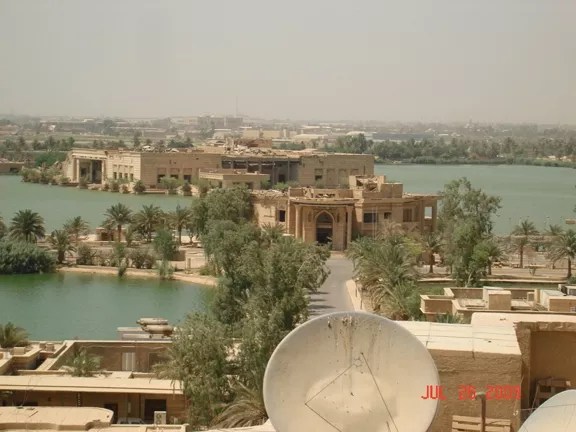
“If I’m asleep and you wake me up the wrong way, it’s like I’m in immediate attack mode,” he said, adding that he’s been going to counseling to address his hypersensitivity and improve his communication skills. “If you question me, it’s very difficult for me, because in Iraq that moment of indecision could have cost either of us our lives.”
Mueller said he also sometimes struggles with the attitudes of his classmates at Allan Hancock College.
“There are people who don’t take their schoolwork seriously. They don’t even want to bother reading the syllabus, and they get mad at the teacher for having to do that,” he said. “I just want to say, ‘You idiot, just read the syllabus!’”
He frequently wishes people knew how good they have it over here, because, in Iraq, soldiers and local citizens were confronted with life-or-death situations every day.
During his time in Iraq, Mueller toured with a striker brigade, a special unit that could be used for multiple assignments.
“You can pretty much go anywhere and do anything and not need much help,” he explained.
Mueller went to Iraq as part of a troop surge implemented by then-President Bush.
“I was sent to Baqubah in the Diyala province. We were told it would be our new stronghold, our new seat of power, where we would make a stance,” he said.
Mueller was assigned to a combat-control line unit that was ordered to “clean up Baqubah.”
“As a medic, you live with [the unit members] and take care of them. Those are your guys. Those are the guys you’re interested in and you make sure they come home,” he said.

Combat medics, he explained, are comparable to paramedics on the streets of Santa Maria, except “you carry everything on your back.”
Mueller said he saw plenty of bloodshed while on tour, but “those certainly aren’t the things in my life I want to focus on. It’s a necessary evil.
“My goal was to treat guys and keep them alive. Maybe they’re not 100 percent, but they’re still alive and they get to go home and be with their families,” he said.
He did share a story about one of the special missions his unit was sent on: “There was a young bookstore owner who was captured because his brother was in the army. [The militants] said, ‘We want to get to your brother, but we can’t because he’s in the army, so we’ll get the next best thing,’” Mueller recalled. “And they grabbed this kid, this 20-something kid, and chained him up and tortured him and threatened to cut his head off after morning prayers. … And we were able to go in and rescue him.”
That was the everyday reality in Iraq, he said. It’s a reality that’s worlds apart from life here in America.
“I mean, could you imagine going into a Barnes and Noble and being kidnapped?” he asked.
But, overall, Mueller said, the Iraqi people are good people who want the same freedoms other people enjoy in more stable, democratic countries like the United States.
“Yeah, we went [to Iraq] and we took out a lot of bad guys who were trying to implement certain religious beliefs and using violence to prevent people from having their own government and the freedoms we enjoy here in America,” he said. “But when you have bad guys like that [in power], the people suffer greatly.
“People weren’t even getting the government-supplied rations of flour, oil, and rice. It might not seem like a lot, but when you’re not getting those supplies for a year, it is,” he said.
For the most part, Mueller said, the people his unit encountered were very grateful for the assistance they received.
“I saw both sides of the coin, and both were mostly to the extreme because I was in a rural area,” Mueller said. “The people were less in touch with current issues. I don’t want to say they were primitive, because that would be insulting. Their needs were more basic. They were either very thankful for help or they wanted to kill us.”
Mueller admits that American forces in Iraq “did some bad things,” adding, “we caused damage and people are dead, but that was because of the choices they made and the punishment they received.”
Addressing the Iraqi people, he said, “We did those things so you can watch whatever TV show you want to, and wear whatever you want, and so you can talk to another man and not be afraid that your husband is going to kill you.”
Still, Mueller said he feels the mission of the Iraq War was not completed.
“We didn’t accomplish what we set out to do, due to outside pressures and the current economic crisis, and I completely understand the reasons why we pulled out. Plus, the Iraq government wanted us out,” he said. “We needed to have the respect to give them the chance to stand up on their own.”
But he said only time will tell whether the people will be able to do that.
“They’re so beat down in the corner by such a strong ruler who used threats of violence and actual violence as a tool. They’re waiting for the hand to come down and crush them,” he said, adding that he’s worried another tyrant will use that vulnerability to gain power. “Now that we’ve pulled out, I’m worried the people we didn’t get are going to start creeping back in.”
But Mueller said he feels encouraged by the political movements going on right now in other parts of the Middle East.
“So many tyrants have toppled this year. The rest of the atmosphere in the Middle East has helped improved Iraq’s chances,” he said. “But if they can’t stand up for themselves, I’m afraid all that money spent and all the lives lost will be a waste. After seeing friends die and other soldiers die, it would be heartbreaking for me if that happened.”
Contact Managing Editor Amy Asman at aasman@santamariasun.
This article appears in Jan 5-12, 2012.
