


Fields of leafy green vegetables and ripening strawberries in the Santa Maria Valley look innocent enough as the food crops get ready for dining tables around the country, their growth spurred by farmers’ addition of synthetic nitrogen fertilizer. But deep below the root zone lurks an unappetizing problem.

A new study by UC Davis scientists shows that plants only use half the nitrogen fertilizer that farmers apply. The other half hops a ride on water molecules and percolates down through the soil, eventually making its way into local drinking-water wells—where nitrate contamination can make the water unfit for human consumption. It’s a serious problem that’s getting worse, according to water quality officials.
Many local growers have been taking steps to reduce their use of costly nitrogen fertilizer in the last few years. Today’s farmers often apply the liquid boost along with irrigation water, using drip lines to feed the plants’ root zones. Some even have their own onsite laboratories, relying on plant science to fine-tune fertilizer application.
But nitrate pollution of groundwater is so widespread that these voluntary efforts aren’t enough for the Central Coast Regional Water Quality Control Board anymore. Now Central Coast farmers are the first in California to face a host of stringent new requirements designed to stem the flow.
“Nothing is more important than making sure people have clean drinking water,” explained Matthew Keeling, a water resources control engineer with the water board. “Many people are drinking water contaminated with nitrates and don’t know it, with associated health costs.”
Social-justice advocates first raised the alarm in the Salinas Valley, where people living in farmworker communities started experiencing various health problems associated with high nitrate levels in their drinking water—traced to heavy use of nitrogen fertilizer on crops.
Nitrogen flows through the environment in a dynamic natural cycle, but, according to the UC Davis report, the balance has been disrupted by the production of synthetic nitrogen fertilizer, made with natural gas.
“You can’t grow fresh produce without adding nitrogen,” said George Adam, owner-operator of Innovative Produce in Santa Maria, as he showed a visitor how the fertilizer is applied to fields of celery plants through drip lines, once or twice a week.
In the past five years, Adam said, he’s been able to reduce the amount of nitrogen he uses on the 1,200 acres he farms, where he grows broccoli, cauliflower, celery, and several kinds of lettuce.
“You get a better crop by applying water and nitrogen just in the root zone. You can control it more than furrow irrigation, where a lot of nitrogen leaches through as nitrate,” he said.
Nitrogen-laden runoff from the fields today is about one-tenth of what it was a few years ago, he added.

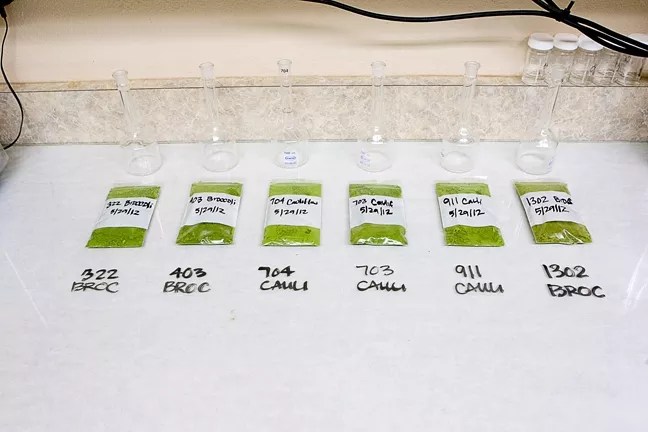
The company’s office on West Main Street now houses a laboratory, where specially selected samples of growing vegetable plants are analyzed to determine their exact nitrogen needs.
“We feel we are doing what’s right for the health of the plants,” Adam explained. “We’re all working on a solution [to the nitrate pollution problem]. But to keep nitrate completely out of groundwater is, quite frankly, unachievable with today’s technology.”
The Central Coast Regional Water Quality Control Board wants to start taking steps to address the nitrate problem. In March, after two days of public hearings, board members unanimously adopted a contentious set of requirements for growers throughout the region, including Santa Barbara and San Luis Obispo counties, as well as the Salinas Valley.
The new rules apply to growers who irrigate their commercial crops—vegetables, wine grapes, orchards, or nursery stock. Each farm has been assigned to one of three tiers, with differing requirements depending on their perceived threat to water quality.
Adam was one of about 80 growers who attended a June 1 workshop in Santa Maria to learn more about how to comply with the strict requirements. About 4,000 farms in the Central Coast region are covered by the new rules, Lisa McCann, the water board’s watershed division manager, told the growers at the workshop.
Tables at the back of the library conference center were laden with stacks of papers full of instructions for growers, including a five-year compliance schedule that kicks in this fall.
Farmers listened intently as McCann explained the various requirements, some audibly sighing, others muttering in frustration at the complex paperwork.
“What a nightmare!” one grower said under his breath, while another agreed, “It’s over the top this time.”
All growers—referred to by water board staff as “dischargers”—are required to develop and implement a farm water quality management plan for irrigation efficiency, nutrients, pesticides, salinity, erosion control, and aquatic habitat protection.
All growers must monitor nearby creeks and estuaries that may receive farm runoff each month, and they must twice sample the groundwater from irrigation and drinking-water wells on their farms, with nitrate levels reported to the water board.
Tier 2 and 3 growers also have to calculate their farms’ risk of adding nitrate to groundwater and record and report the total nitrogen applied to crops of leafy greens and strawberries. Tier 3 growers also must prepare an irrigation and nutrient management plan and a water quality buffer plan, and monitor the runoff coming off their fields.

These new requirements, collectively known as the Agricultural Order, have been appealed by farmers’ groups. Farm bureaus in the Central Coast region, the Grower-Shipper Association of Santa Barbara and San Luis Obispo Counties, and other agricultural groups have petitioned the State Water Resources Control Board to halt the implementation of the new program and to overturn its adoption.
The Farm Bureau petition says the new plan will lead to “dramatic and severe impacts on the agricultural industry, which will have a significant effect on the economic and social environment of the region.”
Richard Quandt, president of the Grower-Shipper Association of Santa Barbara and San Luis Obispo Counties, said in an interview that the rules have “serious economic implications” for agriculture and the entire region. Tier 3 growers will have “great difficulty” complying with the rules, Quandt said.
“The idea is to use less nitrogen—everybody’s behind that. We need to start taking steps to heal the groundwater basin. But it won’t be overnight,” he said.
The State Water Resources Control Board is “still evaluating” the petitions, Phil Wyels, assistant chief council for the state board, said in a phone interview from Sacramento. Due to staffing reductions, there’s a backlog of petitions to consider, he said, and he couldn’t predict when a decision would be made.
“Unless and until the state board issues a stay—which is rare—the order remains in effect, even with the petitions pending,” Wyels said.
“The order is unrealistic in its timetable,” Kevin Merrill, president of the Santa Barbara County Farm Bureau, said in an interview. “We need to work on nitrate levels. The big question is how do we do that in a way that works. We’re making progress in fixing the problem, but the issue is how fast. If we stopped farming today, there would still be nitrates in groundwater for hundreds of years.
“How can we make small steps without going out of business? Nowhere else are farmers required to monitor the water coming off their field. We don’t want farmers to go out of business, or we’ll end up with produce from China or Mexico, with almost no regulations,” Merrill said. “We don’t want local farmers to say, ‘This is too expensive. I’m not going to grow lettuce in Santa Maria, I’m going to grow apartments.’”
Farming in the Santa Maria Valley is “a very precise industry now,” he said. “Growers don’t want to buy more nitrogen than they have to. They’re not just throwing fertilizer on the ground willy-nilly.”
For Charlie Melschau, a manager at San Ysidro Farms on Bonita School Road in the Oso Flaco area, the new rules are already a headache. In his 60s, Melschau has found it difficult to master the online reporting requirements.
“I spent two days just trying to get onto the [water board] website,” he complained at the June 1 workshop. Trying to decipher the coded letters in the final step proved especially difficult.
Looking over a field of head lettuce drip-irrigated with nitrogen fertilizer, Melschau predicted after the workshop that many farmers—“especially the older ones”—may just quit the business rather than complying with the requirements.
Even organic growers like Jerry Rutiz are subject to the water board order. His 30-acre Rutiz Farms in Oceano has been assigned to Tier 2, probably because of its proximity to a nitrate-contaminated drinking-water well in Halcyon, he said. But he believes the organic fertilizer he uses to grow his produce takes a long time to break down and doesn’t leach quickly like synthetic nitrogen.
“This is going to be a lot of paperwork. Farmers hate paperwork. At the end of the day, I don’t want to come home and do an hour of paperwork every day. I wish I didn’t have to keep all these records,” Rutiz said.
“Most farmers are environmentalists. They know it’s not acceptable to be polluting groundwater. But if farmers are pressed too hard, nothing will be accomplished,” he added.
Rutiz believes improvements in education and technology—and the rising price of petroleum-based synthetic nitrogen—are leading to more efficient use of the fertilizer.
“At Cal Poly in the ’70s, I was taught that if 100 pounds of nitrogen grows a good crop, 200 pounds grows a better crop. Now there has to be education that 200 pounds won’t necessarily grow you a better crop. Let’s be smart. Maybe there will be new kinds of fertilizer that won’t release to the groundwater so quickly, or more studies on timing fertilizer application when plants need it,” Rutiz said.
More than a quarter of Santa Maria’s municipal drinking-water wells have nitrates in excess of water quality standards, according to the State Water Resources Control Board’s Geotracker website.

The city achieves drinking-water standards by blending the water from high-nitrate wells with water from low-nitrate wells, according to Utilities Director Rick Sweet. For most of the year, 95 percent of Santa Maria’s water comes from the State Water Project.
Santa Maria city officials are working with agricultural interests to understand nitrate and salt levels in the groundwater “and ways we can work to reduce that,” Sweet said.
“We have to determine what is the scope of the issue, what are the salt and nitrate levels in the [Santa Maria] Valley, and then we can determine solutions and ways to accomplish them,” he said. “The water board is certainly approaching it in a different way. The water board has taken a blanket approach, which may or may not be the solution. The overall one-size-fits-all may not be the best way to address the issue.
“The water board effort is certainly a first step. I don’t know if it’s the most effective step, but it certainly is a step and it can’t hurt,” Sweet added.
Privately owned wells supplying fewer than 15 households aren’t required to be tested for nitrates or other contaminants, once they’ve passed initial inspection by county health officials. If initial analysis shows high nitrate levels, the well owner is required to put in “relatively expensive” reverse-osmosis or ion-exchange treatment to remove nitrates, according to David Brummond, supervising environmental health specialist with the Santa Barbara County Public Health Department.
“We take nitrate contamination very seriously. There are known health effects from high nitrates, especially for newborn infants,” Brummond said.
Privately owned wells fall through “holes in the safety net,” according to water board staffer Keeling, who recommends that county health officials require regular nitrate testing. Domestic wells are the ones most at risk of nitrate pollution because they are typically shallower and are often close to agriculture. Because nitrates are colorless, odorless, and tasteless, consumers don’t necessarily recognize their presence in the drinking water.
The Santa Barbara County Public Health Department is preparing to mend the “holes in the safety net.” A proposed ordinance would require regular nitrate monitoring of privately owned wells with five to 14 connections, according to Brummond. Wells with one to four connections wouldn’t be covered by the ordinance, which Brummond said will probably go before the Board of Supervisors in July.

For nitrate-contaminated municipal water supply wells, water board officials are considering offering grants to help “disadvantaged communities,” such as Guadalupe, Los Alamos, and portions of Orcutt and Nipomo, Keeling said.
Free nitrate testing for private well owners—normally $50 to $70—is also being recommended by the water board. They’re about to launch free nitrate testing in the Salinas Valley, while “the Santa Maria Valley is ground zero No. 2,” he said.
High levels of nitrate in drinking-water wells have been recognized as a problem in California for decades.
“It’s our collective duty to address this. Task forces and more reports are not going to address this issue,” Keeling told water board members in May.
“Our highest priority is protecting water quality—protecting public health and drinking water,” Keeling said in a later interview. “We also want to ensure that we maintain the agricultural productivity of the state. I think we can have both.”
Contributing writer Kathy Johnston can be reached at kjohnston@newtimesslo.com.
This article appears in Jun 7-14, 2012.
