


Most of us have seen them: pointed ears and caramel-colored snouts poking out of the brush at a favorite hiking trail, bushy tails whipping around the corners of country roads, and those vivid eyes, which regard you with intentional nonchalance.
Often spotted at sunset, the coyote—known as Canis latrans by biologists—calls the Central Coast home, and has for millennia.
“I think we all have a coyote story,” said Carey McKinnon, the branch supervisor for the Solvang and Buellton libraries.
McKinnon spoke with the Sun at a Jan. 31 event hosted by the Santa Ynez Valley Natural History Society at the Solvang Veterans Hall, where author and professor Dan Flores spoke and read from his new, best-selling book Coyote America. The library provided a multimedia display, she explained.
Flores’ book and talk touched on the complicated relationship that humans have had with coyotes, from ancient times to the present day. Native folklore and modern concerns about coyotes are found throughout most of the contiguous United States, and Santa Barbara County is no different.
As a Santa Ynez Valley resident, McKinnon has had her own encounters with local coyotes.
“Last summer we had a coyote kind of terrorizing the neighborhood—a lot of cats disappeared,” McKinnon said. “I saw this [coyote] coming up our hillside, and it was just like Dan was saying, he wasn’t afraid of me at all.
“He came real close, and I was throwing some rotten apples at him,” she added. “He just finally stopped, and I think he just, he was bored with me!”
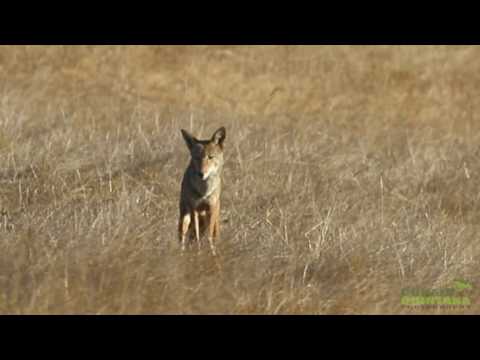
VIDEO COURTESY OF DONALD QUINTANA
The coyote’s attitude toward people isn’t always so cavalier, Flores mentioned in his talk, especially in areas where they are openly hunted.
But the hunting of coyotes by humans is a relatively new challenge for the species, about as new as European colonization, Flores told the Sun in a later interview.
Coyotes coexisted peacefully with people in prehistory, Flores explained. They were deified by ancient tribes, including the Chumash Indians who called the Central Coast home for thousands of years before European contact.
A factor in the coyote’s staying power, and a reason for why they loom so large in Native American legend, is the intelligence they exhibit, Flores told the Sun.
“I think coyotes, of all those animals, reminded them of themselves,” Flores said. “The quality of living by your intelligence and your wit, and being a survivor, those were the two characteristics that made them elevate the coyote into a kind of avatar deity.”
The species’ intelligence has allowed for adaptation to civilization and its many food sources—like McKinnon’s aforementioned missing cats. Ranching cultures, including those in Northern Santa Barbara County, aren’t particularly friendly to coyotes either.
Even locals within the biology and wildlife community can have mixed feelings about the canines. Liz Gaspar, a board member with the Santa Ynez Valley Natural History Society, is a wildlife biologist who retired from years of work as a naturalist at Cachuma Lake.
You’d be hard-pressed to find someone more pro-wildlife than Gaspar, but she shared her own mixed feelings about coyotes.
“I’ve lost a dog to coyotes,” Gaspar said, referring to her small dog Jack, who was “lured away” by a pack of coyotes at a park in Santa Barbara.
“It was heartbreaking, and for a long time I was mad at coyotes for taking my little Jack,” she said. “But I have respect and incredible admiration for them. They were just making a living.”
From the demigod of legend to a hated predator, the coyote has occupied a complicated space in the human psyche. The issues of coexistence, respect, and management—just like the coyote—are alive and well in Santa Barbara County.
From deity to deplorable
Ancient Native Americans had plenty of animals to choose from when constructing their mythology, Flores explains in Coyote America, but it was the coyote that ended up embodying the exalted archetype of creator in their cosmology.
The deified coyote from Chumash tradition had a special name, explained John Johnson, the curator of anthropology at the Santa Barbara Museum of Natural History. The common name for coyote among Santa Barbara-area Chumash was “ashka,” Johnson said. But the deified coyote was known as “Shnilemun,” or “Coyote of the Sky.”
“One of the things that anthropologists have figured out is, when referring to the ‘Coyote of the Sky,’ they’re probably referring to the North Star,” he added. “It’s the star that all the other constellations go around throughout the seasons.”

According to the tales passed down among local Chumash—originally recorded academically by John Harrington, Johnson explained—the “Sky Coyote” plays a Chumash game with sticks, called peon, with the sun every night.
When the Winter Solstice came around, a tally of the year’s games determined the quality of the year to come, Johnson explained.
“If the sun won, then the coming year would be one of harsh drought, no rain, lack of food, and famine,” he said. “But if Sky Coyote won, then it was a good year. There would be lots of rain, plentiful vegetation, wild seeds, crops, and wild game.”
The story places the coyote at the center of the natural world, a major player in it. This is normal for Native American mythology, at least where coyotes were coexistent with tribes, Flores told the Sun.
Coyotes are often described as tricksters, but that’s only part of the story, according to Flores. The coyote deities didn’t just play tricks—they made gambles. They made bad decisions. They had natural character flaws, like selfishness or a gluttonous sexual appetite. It explained everything, like the lay of the land and the reason for a finite life and an ultimate death.
“For some reason, the coyote struck these people 10,000 years ago as the single individual animal that most, I think, represented something to them about the human condition,” Flores said during his Jan. 31 talk. “Out of that choice came what is really the oldest body of literature in North American history, that body of coyote stories handed down through oral traditions among native people, and finally collected by folklorists and ethnographers back at the beginning of the 21st century, and now preserved in print in our own time.”
But the coyote’s public image hasn’t always been so sacred.
Americans called the animal a “prairie wolf” for generations. The term wasn’t totally inaccurate. Wolves, coyotes, and even domesticated dogs can all interbreed and produce viable hybrid offspring, Flores said.
One of the first Westerners to popularize the actual name coyote—a European adaptation of the Aztec name—was Mark Twain in his midlife memoir Roughing It. Twain skewered the coyote, and the public perception of it as a deplorable, prowling, and sneaky beast persisted.
The U.S. government actually waged an open eradication campaign against coyotes in the mid 20th century, after the wolf was essentially wiped out by a similar operation. There was a massive propaganda campaign against coyotes, branding them the “Original Bolshevik,” as detailed in Flores’ Coyote America.
But in the end, after killing tens of millions of coyotes, the massive efforts taken by what is now the Wildlife Service—which is part of the U.S. Department of Agriculture—didn’t even decrease their numbers.
Wildlife Services does continue to kill thousands of coyotes every year, usually at the behest of ranchers, in California and throughout the nation.
Agricultural aggravators
The U.S. Fish and Wildlife Service in Santa Barbara—not to be confused with the USDA’s Wildlife Service—doesn’t actively kill coyotes, but officers do counsel local ranchers on how to effectively remove coyotes from an area, explained Fish and Wildlife Lt. Jamie Dostal.

Santa Barbara County Fish and Wildlife officers don’t receive calls concerning coyotes often, Dostal said, but they have been a concern of local ranchers over the years.
“If they have a crop, or any other type of damage that a coyote could do, we advise them on their rights and whether they want to kill the coyotes,” Dostal said. “We have volunteers who will give the information, who will tell them how to try to shoo them away. That’s what we try to get them to do first, and then they get authorization to kill them if they continue to have problems.”
Fish and Wildlife do euthanize coyotes when necessary, Dostal explained, including one that was being fed by Santa Ynez area high school students.
But as far as local ranchers shooting, trapping, or otherwise killing coyotes, they often don’t reach out to the service at all, he said.
“That’s a pretty common situation in a lot of farms and ranches,” Dostal said. “They don’t often call us or report to us. It’s one of those things that they will just handle themselves; they won’t often ask for our input.”
Coyotes are opportunistic omnivores, so they’ll eat newborn calves or grapes straight off a vine, making them a nuisance to the agricultural community.
Peter Adam, 4th District supervisor for the county, is a third generation farmer and rancher. Adam said that his father and grandfather “didn’t think too much about coyotes,” in an email interview with the Sun.
Adam also said that he became interested in population control in the 1990s, when his oldest daughter was toddling and coyotes were frequently sighted in his Orcutt neighborhood. After some counseling from a local wildlife officer, Adam hunted local coyotes “pretty hard for a decade or so.”
“If there are too many in the presence of livestock, they can be a problem,” Adam said in the email. “Coyotes love tomatoes, strawberries, and wine grapes. They will chew drip hose or other irrigation hardware to get to water or just to play with something. They are very smart and will adapt only too easily to urban development.”
On his own property and on public land, Adam and anyone else can legally hunt coyotes, Dostal explained.
“As far as hunting for sport, coyotes are legal year round,” Dostal said. “To kill them, you just need a hunting license. If they are causing damage, you can take them as well. That is a legal act to do that.”
People, pets, and predators
Adam is right about coyotes—they adapt very well to not just suburban, but urban environments. According to Flores’ book, almost all Americans sleep within 1 mile of a coyote.

On the Central Coast, coyotes live in the open spaces that border and divide its urban centers.
Paul Collins, the curator of vertebrate zoology at the Santa Barbara Museum of Natural History, witnessed what happens when several packs of local coyotes converge when he was studying bat behavior on Vandenberg Air Force Base land years ago.
On one particularly “quiet, still night,” Collins heard the high-pitched howl that is unmistakable.
“Across the valley, I could hear one pack of coyotes yippin’ and yappin’ and making noise, and then all of a sudden, to the right was another pack, yippin’ and yappin’, and then up behind me, another pack yippin’ and yappin’,” he said. “So it was interesting hearing that communication going on at night, of these different packs of coyotes.”
The county’s open spaces between cities include nature reserves, vast tracks of ranching land, and the rural communities where coyotes are often seen.
Even though they’re known to isolate and kill pets like cats and dogs, coyotes usually prey on smaller mammals, like the vermin that follow civilization: rats and mice. They’ve been known to go after chickens, dumpster dive, and eat dog food left outside.
“They know their environment in a big way,” Collins said. “That’s probably one of their most adaptable traits, which has allowed them to function around humans and human-generated habitat.”
Coyotes hardly ever attack people. But just the mere sight of them can cause alarm for some.
Santa Barbara County Animal Services has received calls about coyote sightings before, explained Operations Manager Dori Villalon.
“We received a call where somebody wanted to report that there was a coyote, and I confirmed that it wasn’t ill, or injured, or menacing anybody,” she said, “and then I had to explained, “Yep. We coexist with coyote.’
“It is certainly something for pet owners to be really aware of and respectful of,” she added. “An urban coyote is smart, and knows how to prey upon small dogs and cats, and people who see them in their neighborhoods should know that it’s a risk.”
Villalon said that locals can take a few precautions to protect their pets, like keeping them secured indoors at night. Feeding pets inside, and limiting any food sources outdoors helps too.
“I certainly think of them as urban wildlife,” she said. “They’ve learned to adapt to living amongst us, and probably so much more than even we realize because they are so good at camouflage.”
Trying to maximize human and coyote coexistence has become an important mission for one Santa Maria native, Jaymi Heimbuch, who now lives in the Bay Area. Heimbuch, a photographer and writer, began the Urban Coyote Initiative as a photojournalism series in 2015.
The initiative is now a collective of photographers and filmmakers, she told the Sun in an email interview, that collaborate to “advance science-based awareness of urban coyotes, the role they play in healthy urban ecosystems, and strategies for urban residents to live peacefully alongside this adaptable canid.”
Heimbuch also said that she understands some of the anti-coyote animus felt throughout the country, but added that education is the antidote.
“Folks have a hard time coexisting with predators, and no wonder,” she said in the email. “It’s natural to fear and hate something that holds any potential in harming us or our property. … It’s key to address what it is people are really feeling—fear, frustration, confusion, helplessness—and provide information and tools that directly address those feelings.”
Local wildlife photographer Donald Quintana—who shared images with the Sun for this story—hopes his photography serves the same function, not just for coyote. Quintana said he’s never felt threatened by the coyotes he has photographed or encountered, and argued that coyotes don’t need to be killed or quelled, and that they’re beneficial to humans.

He also argued that coyotes aren’t actively dangerous to people, and shared a story of one of his coyote encounters.
“I was photographing a kite in a tree. I wasn’t paying attention, the coyote wasn’t paying attention, and he comes trotting down the trail and runs into me,” Quintana said. “We both kind of yelped. And then he went on his way, and I just sat there, like, ‘Whoa, did that really just happen?’
“What we really need to do is learn to live with the coyote and understand that they’re beneficial,” he added. “And, for me, I’m pro-coyote because I’ve never had a negative run-in with a coyote. I mean, I’ve literally had a run-in with a coyote, and it wasn’t negative.”
Even those with a more hands-on approach to coyote control don’t fault them for eating domesticated animals. Supervisor Adam said he has found the remains of house cats while ranching, which were probably preyed on by coyotes, he speculated.
But he also noted the “service” they provide by eating mice, gophers, carcasses of already dead animals, and even cattle afterbirth. Adam explained that he, and the ranchers he knows, “do not hate coyote.”
“You can’t blame them for doing what God put them on the planet to do,” Adam said in the email. “We simply look at them as an aspect of the land to be managed along with everything else.”
Here to stay
According to Flores, trying to eradicate, relocate, or dwindle the population of coyotes actually has the opposite effect. It was the U.S. government’s efforts to destroy them that spread the coyote across North America in greater numbers than when the program began.
Coyotes are able to break their packs into smaller groups, Flores explained, even down to pairs or single animals, when they are under threat. They can flee danger in many directions, adapt effectively to new environments, and then repopulate quickly.
The coyote population actually booms when there are fewer of them in an area, Flores explained. This has to do with their howling behavior, a form of communication between packs. When a coyote pack howls and yips, but receives no reply consistently across several days and miles of landscape, an epigenetic trigger goes off in the females, resulting in large litters of pups. In these conditions, they can deliver as many as 15 or even 19 pups in one litter, Flores said in his talk.
Because of this, all attempts to destroy the coyote so far have completely failed.
“These animals have been evading our solutions for 125 years,” Flores said. “So, all the wildlife management programs that are in place in cities all around the United States, their idea is not to eliminate coyotes, it’s to get people to learn how to coexist with them. I mean, the coyotes know how to do it; it’s the people that have to learn how to do it.”
This survival game is something coyotes have done for millions of years, Flores explained. Coyotes were one of the few large mammals to survive the late Pleistocene extinctions, which took place around 11,000 years ago and wiped out large mammals like mammoths and the saber-toothed cat.

The coyote’s resilience, adaptability, and intelligence didn’t go unnoticed by Native Americans like the Chumash at the time, Flores contends, which was probably the inspiration for the coyote’s mythos in those cultures. A consummate survivor that could work in a team, solve problems, and share knowledge served as an inspiration and source of reflection for ancient people, he said.
Whether teaching their young how to hunt rabbit or domesticated animals, coyotes pass down the knowledge it takes to survive in their environment, Flores said. This cultural connection is one that surely inspired natives, he said.
Coyotes in Santa Barbara County certainly have plenty of food sources to choose from, both wild and domesticated. But unlike the wolf ancestors of our domesticated dogs, the coyote’s way of life has always been on the wild side, Flores explained.
“Coyotes have never chosen human domestication,” he said. “They’ve chosen to be among us, and to circulate in our presence in order to take advantage of the kinds of prey that we generate, but they never made that step of choosing to be domesticated animals.
“They took our measure a long time ago and decided they could get the benefits from us without having to surrender their freedom,” Flores added.
Contact Managing Editor Joe Payne at jpayne@santamariasun.com.
This article appears in Feb 23 – Mar 2, 2017.
