


The gleam of laptop screens reflected off Sebastian and Tristan Thau’s glasses as the brothers—aged 11 and 7, respectively—navigated an online interface. The siblings shared one side of a table at UCode, an Orcutt business that teaches kids computer programming languages and techniques.
The two quickly booted up a number of games and applications they learned to create during their twice-a-week visits to UCode. Sebastian, the older brother, displayed a program called App Inventor on his laptop screen, revealing lines of color-coordinated computer code.

“I do coding on Scratch and App Inventor a lot,” Tristan said. “I actually just made this; it’s a fortune telling 8 Ball app.”
Pulling a tablet seemingly out of nowhere, his slender fingers swiped and tapped until the app coded on the laptop screen appeared on the tablet. A black 8 ball familiar to pool and billiards players was stationary on the screen.
“So, um, you ask it a question, and shake it,” he said. “Like this: ‘Will I be on the news?’”
Sebastian gave the tablet a quick shake with two pumps up and down. The app responded with a chime and the word “Yes,” printed across the screen under the 8 ball.
“See, it knows,” he said playfully.
“So, it pretty much does a random response,” he continued earnestly. “I typed in, like, a bunch of responses and coded it so when you shake it, it brings up a response. You can make pretty much any kind of app, and it can use variables like the camera, the microphone, or if you shake it or not.”
Sebastian’s younger brother, Tristan, was busy pulling up one of his games on Scratch, an online coding resource that UCode students can access both at home and from the business. The 7-year-old selected one title from a list of several games he’s created.
“This is one of the games I made on my own: It’s called Supercraft, because I love Minecraft,” Tristan said. “This is the store where you can buy different kinds of armor, and I have a secret cheat button that only me and my brother know about, so yeah, I can just spend all my money on diamond armor.”
Once he got stocked up on armor, Tristan continued into the game’s battle mode, where a blocky main character controlled by arrow keys and the mouse avoided and attacked an incursion of enemies, who were also depicted in a blocky, simple style reminiscent of Microsoft Paint.
“He drew them himself,” his brother said. “Those are sprites, and he can draw them in the program.”
Tristan clicked a button within the program that scaled the game play window to a smaller size, revealing another interface filled with long stacks of code, a kind of under-the-hood view of the game. He revealed the inputs for the characters he drew, and even the line of code that created his secret cheat key.
“I kind of want to be a computer programmer when I grow up,” he said. “I pretty much already am, I mean, I’m already doing Javascript.”
Scratch before Java
UCode teaches kids as young as 5 years old to code with a trademarked project-based curriculum. Students immediately begin making simple games with Scratch, a program that offers a sort of visual depiction of computer code, serving as the entry level for more complex coding languages like Javascript, HTML, or C++.
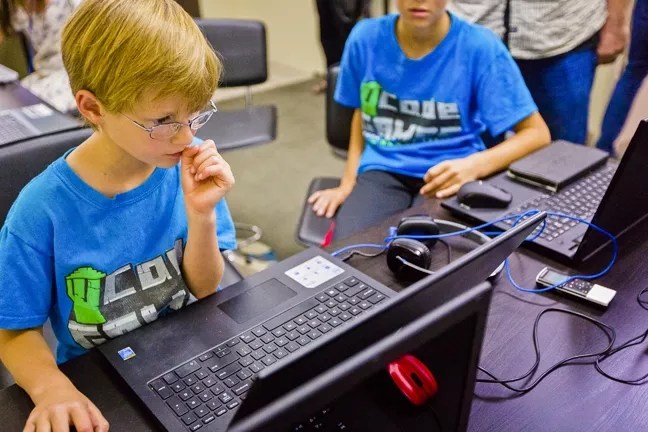
Classes stay small, explained Santa Maria UCode Center Director Andrew King, so that each student gets individual attention and guidance on their projects.
“The idea is you come to UCode, you follow along—now, go out and make something,” King said. “They follow along with instructional videos, but there’s also room for them to put their own spin on it, and we encourage kids to get creative and take what they learned home and apply it to different projects.”
King met the company’s co-owner and creator, Scott Mueller, in Lompoc after helping out with an after-school program facilitated by UCode. King’s expertise and excitement about the program elicited the opening of Santa Maria’s own UCode, located on Clark Avenue in Orcutt. UCode also has locations in Beverly Hills, Hermosa Beach, and Torrance/Palos Verdes.
Families that sign up one or more kids enjoy a designated time during the week when the kids can learn basic principles and apply them to a particular game. The curriculum is designed so kids progress to more complicated coding languages once they understand underlying fundamentals, King explained.
Programs like Scratch and App Inventor do most of the dense code work, guiding the programmer like they’re on rails, still teaching the particular structure and grammar of coding languages. This is a far cry from the way programmers like King learned to apply and execute computer code.
“What really gets me with that, is the simplicity of Scratch, where you can poke around and figure things out,” King said. “It’s drag and drop, so we have kids who didn’t know how to read or type, and they were going off of pattern recognition, which is remarkable.”
Parents like Brandon Thau and Christina Engel—Tristan and Sebastian’s father and mother—have seen a marked difference in the way their kids learn. The incentive is creating a new game the boys are excited to play, which makes learning and applying skills like math, reading, writing, or typing a means to an end.
“Tristan pretty much learned how to read from wanting to read instructions on how to do different programming when he started learning Javascript,” Engel said. “And his typing is really amazing for a 7-year-old.”

The UCode website boasts that students learn critical thinking and problem solving skills. The Thau boys both attest to the fact that UCode helped them with their math classes at school. Sebastian remarked that coding also helps him process and understand languages like English.
“I think it’s the motivation of the game that helps propel them in all the other basic skills of the computer,” Thau said. “They certainly troubleshoot on their own a lot more; I don’t get bothered as much about fixing little things that go wrong with their computers.”
Though the tasks and projects are guided, and students often receive help from King, each endeavor presents a unique set of objectives and obstacles that students must overcome. For younger students, improving skills like reading and writing is a precursor to seeing their cool animated character move across the screen. And working toward more complicated languages does pose a healthy challenge.
“Javascript it actually harder than the first two programming languages they teach, so it’s a little harder for a 7-year-old to get into,” Engel said. “But it was really good for Tristan to work through something like that and get frustrated for a little while and realize that if he persisted with it and worked through it he could accomplish a lot of things.”
Coding creativity
Video games are often regarded as a waste of time, a completely superfluous form of entertainment. UCode tries to dispel those negative notions with student involvement in the process. The program is designed—as the UCode website says—to transform kids “from passive consumer to passionate creator.”
The creative nature of coding is well understood by local programmer and software designer Dave Machin, whose son, Simon, attends UCode classes. Machin sold online software he developed to a company in Salt Lake City, and it’s software he still supports full time through that company. Machin understands intimately the value of the knowledge his son gains during his UCode sessions.
“Javascript is a real language; it’s a language that I use at work all the time,” he said. “It’s a language that people use to write websites for real, which is really cool, because they are teaching him a legitimate skill. If he wanted to get into making websites, Javascript is what he will need.”

Machin explained that his son is motivated to create more complicated games. The 11-year-old is working to master Javascript, which can only take an aspiring game developer so far, so he can graduate to more complex languages.
“He’s played video games like any other kid, but not until he started learning how to program them did he start to really understand how you would go about designing a game,” he said. “I think he understands now that it takes a lot more effort than he thought.”
Many of the youth who sign up for UCode, Machin’s son included, are initially attracted to the program because of its use of the game Minecraft, an artfully blocky sandbox game that allows players to harvest resources and build structures in a virtual world.
UCode locations have gaming hours on Saturdays when UCode students can meet and play games like Minecraft together. It’s also a chance for the kids to share the modifications they’ve made to the game, creating their own characters, weapons, tools, or other items.
“UCode was kind of selling their services with a lot Minecraft related advertisements when we signed him up, and he was getting really curious about how to mod Minecraft,” Machin said. “It was also good for him to meet some other kids who were interested in some of the same things he was.”
Leveling up
With a programming dad to look up to, Simon hopes to enter a career in video game development, Machin explained. After moving up to games more complex than Minecraft, his son began to appreciate the wide range of interests that can foster such a career path.
“There are a lot of skills that overlap with game design,” Machin said. “You can do art and game development, math and game development. There are musicians in game development, so it’s a broad range of skills that he can incorporate his kind of hobbies and talents in; those are the kinds of conversations we have about it.”

Thau and Engel certainly think their boys could be successful in a career path involving coding, but it’s not central to why they signed up Sebastian and Tristan. An understanding of computers will aid in just about any career path they choose to pursue, Engel said.
“In this day and age, anything that is related to helping them understand technology will aid them in any career field they go into, whether they become programmers like they say that want to now, or whether it is something else,” she said. “We chose to take our kids to public school, and honestly, in this area, technology is not as advanced as in some private and public schools, even, so for them to get this technological education outside of school, even though this is an expensive program, we feel it’s a worthy investment.”
Machin knows the skills his son learns at UCode are already helping him get ahead in his education. Simon enjoys sharing his UCode projects with friends online in the form of YouTube videos, Machin explained, which results in video editing and production skills his son uses to create multimedia book reports or complete extra credit assignments.
Thau, Engel, and Machin all share one thing in common: They’re acutely aware that their kids have the potential to waste vast amounts of time on the computer, but are also building invaluable skills that will aid them in the future. Which side of the coin each kid is on isn’t always apparent, but one thing’s for certain: They’re motivated.
“It’s a tightrope line to draw, because if he sees it as a game and has fun doing it, has friends over, and they create games with the computer, and they are enjoying it,” Machin said. “But, he is learning some practical stuff.”
“I try to stay out of it because he doesn’t realize that he is learning,” he added. “For some people, what he is doing for fun, that’s their job; I just hope he keeps having fun.”
Contact Arts Editor Joe Payne at jpayne@santamariasun.com.
This article appears in May 7-14, 2015.